-
info@aaanimalcontrol.com
Call us for help in your town
Humane Wildlife Education
How to Get Rid of Flying Squirrels
We are experts in flying squirrel control methods, having performed thousands of flying squirrel removal jobs nationwide.
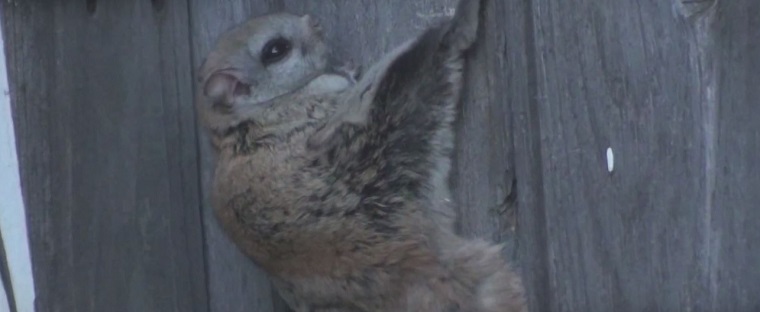
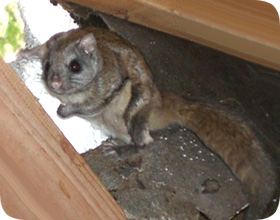 Flying Squirrels got their name because of their ability to glide in the air making it appear as if they are actually flying. They have special parachute-like membranes stretching from their waist to their ankles which help them in gliding. They can be real nuisance as they chew away the wires in building which can result in fire due to short circuits. Their droppings and urine stains creates a mess of the floorings, carpets and other valuable items. They cause monetary damage by chewing away the wooden materials. They are also known to spread diseases such as typhus and rabies. They eat away the food kept in bird feeders and dig holes in the garden. If you have a problem with flying squirrels in your area, consider some of the following options.
Read below for much more detail. You may be able to solve your flying squirrel problem yourself. If you need to hire professional help, you may want to find out what we typically charge for flying squirrel
removal. Pro help is most relevant if you are unable to effectively or legally trap and relocate animals, or if you have a difficult case. If you need flying squirrel removal in your hometown, we
service over 500 USA locations! Click here to hire us in your town and check our prices - updated for year 2020.
What are the Symptoms of Flying Squirrels In a House
A colony of flying squirrels may contain as many as 20 creatures, all looking for food to eat and things to chew on in order to keep their teeth from overgrowing.
If this colony of flying squirrels happens to have taken up residence in your attic, you can imagine that you are going to have quite a problem on your hands. Flying squirrels can cause vast amounts of damage to your home –
they will chew their way in and continue chewing the whole time they are there, they will chew wiring, wood, furniture, floors, doors, windows etc etc. They may well chew their way from the attic into the ceiling space below!
They also have a unique odor that quickly permeates the attic and home, as they use the attic as a latrine.
If you have a colony of flying squirrels resident in your home, you have no time for sentiment or feelings of guilt – you must get them out as quickly as possible before they cause huge amounts of damage to your home.
The only sure-fire way of removing flying squirrels is by trapping them and removing them – or killing them if your local state regulations allow. Trapping does take time and patience, you must be sure to get the whole
colony out, and once you have done that take some time to seal your home – every nook and cranny, every hole and gap – in order to prevent the flying squirrels coming back.
Important Steps to Take
The first and probably the most important thing to do is to cut out as much of their food supply as possible. Food supplies for flying squirrels include waste materials and pet food as well. Garbage cans are an excellent way for squirrels to get their food; therefore, if you are using garbage cans outside the home be sure they are metal cans with lids that cannot be easily opened or chewed through by the flying squirrels. If you have the ability to place the garbage cans in a secured area, this would be a better choice. Removing the bird feeders for the time being is also a good option as you cannot stop the access by using squirrel baffles.
Cutting of the branches of trees around the house also helps as it will restrict their flight to some extent. Try to block their entry in the house through various openings by closing them temporarily. Once they are trapped, you can open these again. There are also sticky materials available in the market that can be applied to various surfaces used by flying squirrels to climb. This sticky material does not allow them to crawl up easily.
The Repellents
Naphthalene or moth balls are sometimes used as repellents to try to drive away flying squirrels from the home. However, repeated field testing has shown that no repellents work to keep out or drive away Flying Squirrels. People try to look for the possible opening used by them to enter or exit the house and place moth balls on all of these
excluding one. The one area left opened would be their way to escape and move out of your home. People also put the moth balls in and around the area where they are residing such as the attic. I've been to attics loaded with cancer-causing
mothballs, but the squirrels don't care in the slightest. However, people can get sick, headaches or even cancer from too much mothball exposure.
Also, there are a number of taste repellents available in the market which can be sprayed on the plants, trees, fruits, fences and poles. According to the advertisements, these repellents will discourage the squirrels by making your vegetation taste 'wrong' to them and they will look elsewhere for food.
While repellents sound like a good idea, they really are not all that effective in actually getting rid of flying squirrels. The majority of the repellents on the market will not work as they claim and will usually just end up costing you money and time. Repellents can also have the undesired effects on your plants and pets and could even end up attracting other types of animals that are not repelled by the squirrel repellents.
Trapping Flying Squirrels
Trapping the flying squirrels is easily the best way to get rid of them. However, trapping them is by no means an easy task and getting an expert to do the job is always the better option. There are a number of cage options
in the market that you can find. Remember to buy one that has small mesh so that the squirrels will not be able to escape. Squirrels can be 'squirrely' which means you might want to start by placing the 'bait' somewhere near
the trap and keep moving it closer each day until you are able to put the bait inside the trap to lure the squirrel into believing it is safe. Close and secure the openings
once they are gone.
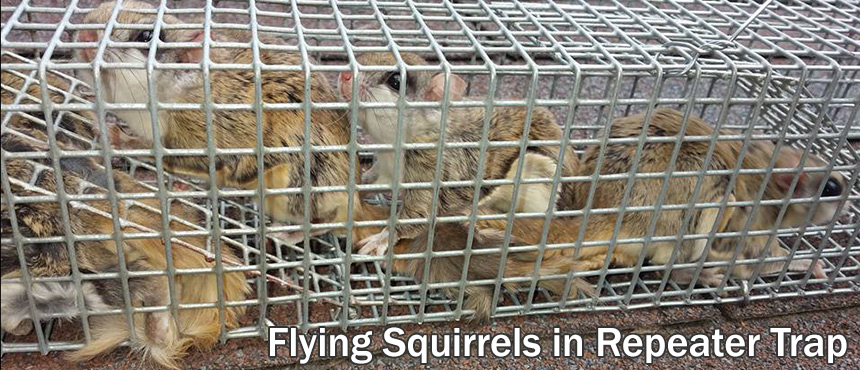
Commercial live traps and repeater traps can both be used to catch the flying squirrels. Commercial traps can hold only one squirrel while repeater traps can catch more than one. You would need to carefully observe the path they follow and find out all the entry and exit points from the house. Once you've figured out their paths, place the traps strategically in order to catch them. An important thing to note here is that if the traps are placed at the wrong places, you would never be able to catch a flying squirrel. This is where a professional help might be useful as it can increase the chances of catching one many fold.
How to Get Rid of Flying Squirrels in the Attic
Squirrels in an attic can be problematic, but the type of problems you experience will depend greatly on what kind of squirrel problem you have. Flying squirrels are less destructive than regular squirrels, which is good. The problem with flying squirrels is that they usually appear in large, family communities of ten or more. These squirrels will quietly invade your attic where it's warm, quiet and safe, and then they will go about their business like normal until one of two things happen: loud noises from their communal activities drive you crazy, or you see an unsightly brown liquid oozing into your ceiling tiles. If noise is your only issue—just wait. The brown ooze some homeowners notice is because flying squirrels select common bathroom locations. The moisture from this growing pile of waste will eventually do serious damage to the materials below it. The get rid of flying squirrels, use live traps such as one-way door traps and repeater traps. Find the entry point into the attic and install the one-way door. Inside the attic, install a few repeater traps or cage traps. When baited with peanut butter, the traps are hard for squirrels to resist. Once you have captured all the squirrels in the community and relocated them, seal up any entry holes around your attic. Because they live in large communities, make sure you have all the squirrels and babies removed before you patch the holes in your attic.
How to Get Rid of Flying Squirrels in my Yard
Flying Squirrels in a yard are rarely an issue, but if you've got a family of the little creatures living in a nearby tree, you may want them trapped and relocated. Flying squirrels are active during dawn and dusk, rarely going outside during the main part of the day. For this reason, the problems associated with most yard squirrels rarely extend to flying squirrels. It is very hard to eliminate squirrels from a yard, especially if you live next to a wooded lot. Accept the fact that you will never be squirrel-free, but that you can use some methods to exclude them from your property. Fences are a poor defense against this adept climber. Instead, barricade your home, and make sure that there is no way the squirrels in the tree can become squirrels in the attic. You can attempt to trap the flying squirrels, but this will be very difficult, and you may end up trapping more regular squirrels than flying ones. For squirrel colonies inside of a tree in the yard, professional help is advised to ensure the correct animals are removed and the tree is rendered uninhabitable.
How to Get Rid of Flying Squirrels in the Shed
Sheds and outbuildings are excellent areas for flying squirrels to take over. Not only do these buildings provide the same shelter and safety as an attic, they are often less frequented by people, and squirrel activities can go unnoticed for long periods of time. Shed often have unfinished interior roofs, providing lots of nooks for a flying squirrel family to nest in. The good thing about squirrels in this type of building is that they have little space to escape into, so trapping is relatively easy. Flying squirrels in a shed can be trapped with live traps. The most effective live traps are exclusion traps and repeater traps, though in a large space such as a shed, single use, cage traps can be used. Bait the repeater trap with peanut butter and place it in the shed, along the wall. The exclusion trap should be attached to any entry points the squirrels are using to get into the shed. When the flying squirrels enter the one-way door trap, they will be unable to go back into the shed. Once all the squirrels are captured, do a complete check of your shed to make sure no infant squirrels were left behind. Flying squirrel mothers are ingenious at hiding young, so be sure to check inside of everything, even under the decks of your lawn equipment. If all the squirrels are gone, clean out their nests and seal off the entry holes.
Other information about flying squirrels:
Will repellents get flying squirrels out of the attic?
About Flying Squirrel: Appearance, biology, life cycle, habitat, diet, behavior
Do flying squirrels chew on wood or electrical wires? Why, and what are the risks?
Flying Squirrel Exclusion with One-Way Door
How to trap or exclude flying squirrels
Flying Squirrel Prevention - How to keep Flying Squirrels out of house
How to kill flying squirrels
How do you know if you have flying squirrels in your attic?
How to get flying squirrels out of the attic
Can a Flying Squirrel actually fly?
Select Your Animal

Raccoons Raccoon Removal Advice & Information

Squirrels Squirrel Removal Advice & Information

Opossum Opossum Removal Advice & Information

Skunks Skunk Removal Advice & Information

Rats Rat Removal Advice & Information

Mice Mouse Removal Advice & Information

Moles Mole Removal Advice & Information

Groundhog Groundhog Removal Advice & Information

Armadillos Armadillo Removal Advice & Information

Beaver Beaver Removal Advice & Information

Fox Fox Removal Advice & Information

Coyotes Coyote Removal Advice & Information

Birds Bird Removal Advice & Information

Bats Bat Removal Advice & Information

Snakes Snake Removal Advice & Information

Dead Dead Animal Removal Advice & Information

Chipmunks Chipmunk Removal Advice & Information

Voles Vole Removal Advice & Information

Deer Deer Removal Advice & Information

Flying Squirrel Flying Squirrel Removal Advice & Information

Gophers Gopher Removal Advice & Information

Prairie Dog Prairie Dog Removal Advice & Information

Feral Pigs Feral Pig Removal Advice & Information

Alligators Alligator Removal Advice & Information

Iguanas Iguana Removal Advice & Information

Muskrats Muskrat Removal Advice & Information

Nutria Nutria Removal Advice & Information

Otters Otter Removal Advice & Information

Pigeons Pigeon Removal Advice & Information

Goose Goose Removal Advice & Information

Muscovy Duck Muscovy Duck Removal Advice & Information

Starlings Starling Removal Advice & Information

Woodpecker Woodpecker Removal Advice & Information

Porcupines Porcupine Removal Advice & Information

Rabbits Rabbit Removal Advice & Information

Weasels Weasel Removal Advice & Information

Stray Dogs Stray Dog Removal Advice & Information

Stray Cats Stray Cat Removal Advice & Information

OthersOther Wildlife Species Information