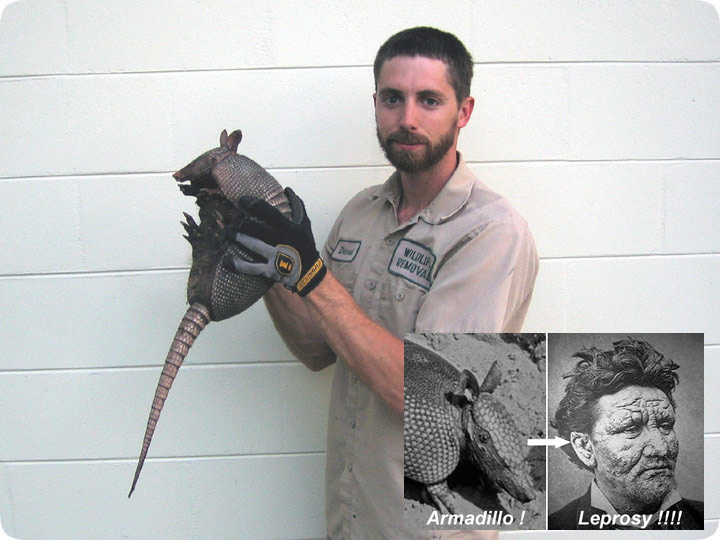
One of the bits of wildlife trivia that I'm often exposed to is the one about armadillos and leprosy. Every now and then, a concerned friend/relative or a brilliantly informed customer will inform me that I shant
touch armadillos, because the animal is known to carry the dreaded disease. Well, it's true that armadillos can carry leprosy. It's also true that I handle armadillos all the time. I usually wear gloves, not for
biohazard protection, but because I have clean and dainty hands, and choose not to sully them with armadillodirt. I'm not actually worried that I'll contract leprosy. It's not just that the odds appear to be in
my favor: after all, only about 5% of armadillos carry the disease (or so I've read) and about 95% of people have a natural immunity to the disease (or so I've read) and I'm an optimistic fellow. I figure this is
another one of those wildlife issues, like venomous snakes or killer sharks in which I've got a 1000% better chance of dying on the car drive to trap/relocate the animal as from the animal itself. But to be more pragmatic about
it, I don't think there's any documented cases of leprosy transmission from armadillos to people.*
Leprosy, also known as Hansen's Disease, is a bacterial disease. The leprosy bacillus usually inhabits the cooler extremities of the human body (hands, ears, nose). It's theorized that the armadillo can carry it because of yet another fascinating
armadillo trait: low body temperature. Armadillos usually maintain a body temperature of around 90 degrees
Fahrenheit. This provides an environment conducive to the bacterial growth. Furthermore, armadillos can live for a
long time, which gives the slow-developing disease a chance to take off and do its dirty business. Thus, armadillos are used in the study of leprosy, since it's apparently impossible to grow the bacteria in a laboratory
environment. In fact, according to the reports, researchers collected the animals in the 1960's, merely guessing that they'd be good test subjects to introduce the disease to, and found that many armadillos already had
leprosy. I think these research efforts have resulted in the development of a vaccine, but it's not 100% effective.
*UPDATE - I just read, on 4.27.2011, that armadillos HAVE transmitted leprosy to people. In an article titled "DNA tests link Southern leprosy cases to armadillo", it was revealed that government researchers
at the National Hansen's Disease Programs in Baton Rouge, LA found that the DNA from leprosy samples of both armadillos and leprosy patients in the southern USA matched, and that this DNA was different from the
leprosy DNA in other parts of the world. Apparently you've got to, like eat armadillos or frequently handle them or cuddle with them or something in order to get the disease. Apparently 150 cases pop up in the US each
year. It's not known how many are due to dillos, but most of the cases are in dillo range. Huh. So there you have it. This explains why my nose fell off last week.
The risk of contracting leprosy increases if one eats the animal. I have handled many armadillos, including with my bare hands, but I have never eaten armadillo meat, although I have met many people who have. Some people
are just curious about the taste, and others are simply more akin to bushmeat hunters, who will eat anything. I'm sure, as with any food, armadillo is "considered a delicacy" in some parts of the country. Everything is
considered a delicacy by someone. However, after learning about the risk of contracting leprosy due to eating dillo meat, perhaps people will consider abstaining from dining on dillo on the half shell.
Read my full armadillo blog! Visit my Armadillo Blog for all kinds of armadillo stories.
Do it yourself: Visit my How To Get Rid of Armadillos page for tips and advice.
Get professional help: Visit my Nationwide Pro Directory of wildlife removal experts.