-
info@aaanimalcontrol.com
Call us for help in your town
Humane Wildlife Education
How To Get Rid of Mice
We are experts in mouse control methods, having performed thousands of permanent mouse removal jobs nationwide.
Read below for much more detail. You may be able to solve your mouse problem yourself. If you need to hire professional help, you may want to find out what we typically charge for mouse
removal. Pro help is most relevant if you are unable to effectively eleminate all the mice in your house, or if you have a difficult case. If you need mouse removal in your hometown, we
service over 500 USA locations! Click here to hire us in your town and check our prices - updated for year 2026.
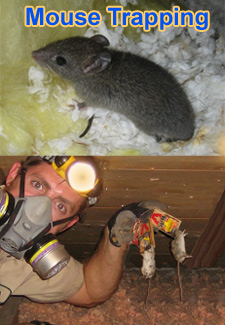 How To Get Rid of Mice: Complete & permanent
mouse control is simple in principle, but it is not easy. The only real
thing you need to do, in order to get rid of mice in your home or attic
permanently, is to seal all holes leading into the house/building shut.
That way, no mice can get inside the building. The problem is that mice
can fit through very tiny areas, so every last hole, gap, vent, etc. must be sealed shut, or you will
never solve your mouse problem.
How To Get Rid of Mice: Complete & permanent
mouse control is simple in principle, but it is not easy. The only real
thing you need to do, in order to get rid of mice in your home or attic
permanently, is to seal all holes leading into the house/building shut.
That way, no mice can get inside the building. The problem is that mice
can fit through very tiny areas, so every last hole, gap, vent, etc. must be sealed shut, or you will
never solve your mouse problem.
Once all entry points have been sealed, it is a fairly simple matter to set traps throughout the house, attic, basement, and wherever the mice are found, and trap and
remove all of them. And that's it, basically, the problem is solved. No other method, such as mouse repellents, or poison will actually solve the mouse problem. In fact,
these attempts will likely make the situation worse.
The only problem is that it is not simple. It is very hard to do right, and it takes a lot of work. Here are step-by-step instructions for how to get rid of mice
the correct way:
STEP 1 - The Inspection: This is a crucial part of the process, and the hardest part. If you want to get rid of mice permanently, the one and only way to do it
is to find out how they are getting inside the building to begin with. Mice can fit through very small holes - as small as a dime, or more commonly, through gaps in
building architecture, as small as 3/8 inch. You have to inspect every last bit of the house, from ground to roof - all vents, dormers, soffits, roof lines, inlet and outlet
pipes, loose siding, etc. Learn more about: How do animals get inside a house?
STEP 2 - Seal the Openings: As you find the openings, seal them shut, so that no more mice can ever get in. Mice are rodents, and can chew, so you want to seal the
holes and gaps shut with steel mesh, or screw in metal flashing. I also like to use a sealant that blocks off air flow - such as silicone caulk or
polyurethane, so that mice
can't smell the former entry hole and try to chew their way in. If you don't seal off EVERY opening, you'll never fully get rid of the mice forever.

STEP 3 - Trap the Mice: Only after you've sealed the building shut - that's right - should you even bother with mouse trapping. If you trap while they can still get in
and out, it's a futile effort, and catch rates will be lower. But once you've sealed the building, the mice that are now locked inside will be very easy to trap. Just set the
snap traps in the areas the mice frequently run - you'll see droppings and other signs - and you'll catch them all. I like Victor wooden mouse traps, baited with peanut butter.
But remember, trap brand and bait hardly matter at all. Location of trap is far more relevant. Read more about how to trap mice.
STEP 4 - Clean the Waste: After the problem is solved, you'll want to
remove and vacuum up all the mouse droppings (pictures here) and decontaminate
the area they were living in, to kill all pathogens and mold that grows on the feces and urine. Mice also leave behind a scent that attracts new mice, so this cleanup process
eliminates that scent. I fog the area with a special atomizer and enzyme-based cleaner.
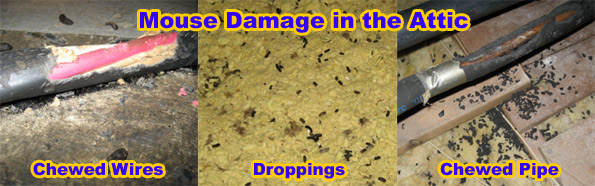
Why would you want to get rid of mice? Most people object to the noise of scurrying and scratching in the attic or walls, but mice can cause
quite a bit of damage, and spread diseases. Read more about how to get rid of mice in the attic, which is the most
common problem area with mice, and also about how to get mice out of your walls. If mice are in the home or kitchen,
the same rules apply, but be mindful of where you set the traps, in case there are fingers that could get snapped.
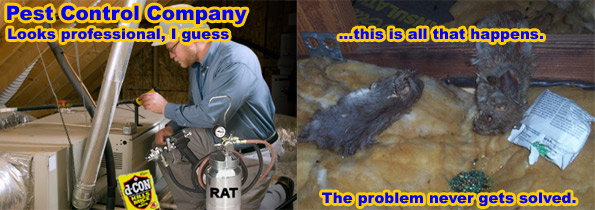
What if you need to hire help? Mouse control is not easy. In fact, it often takes professionals such as myself a couple of years, and dozens of jobs, before we
get really good at it. It's very hard to find all the openings, to understand mice and how they get into buildings, how the architecture works, and the subtleties
of trapping. It's absolutely not easy or simple! If you want to hire a pro, I do recommend that you find someone in your hometown from my Directory of Mouse Removal Professionals.
If you have any doubts about hiring someone, or are unsure of who you should hire
amidst all the choices out there, read my How To Guide: Who should I hire? This tells you what questions to ask. First and foremost, you want
someone competent and skilled, and never ever hire a regular pest control company that uses poison. Read why here on my how to kill mice guide.
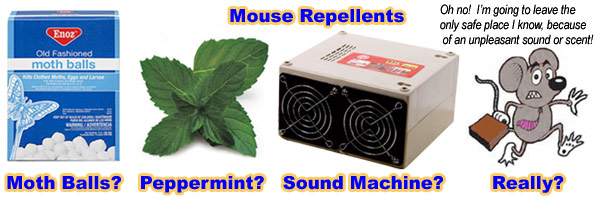
Can't I just use a repellent to get rid of a mouse? Absolutely not! The internet is full of retailers trying to make a quick buck, but mouse control is not so simple! If it was as easy as using
some sort of repellent, mankind would have well known about it for a long time. And new technological attempts, like high-pitch sound machines or strobe lights are a joke. Read more about
Do mouse repellents work here, in order to be properly educated about the subject.
Does a cat keep mice at bay? Cats actually do help, since they are very effective hunters. But cats are not of any help when you have mice in the walls or attic. Plus, cats catch mice every now and then, but
there are always more. If you see one mouse, are there more? Absolutely! For each mouse you do see, there are usually 50 or more in the attic or walls with nests, that you never see. They often sneak into
your house at night to search for food. A cat will catch a few of them, as will snap traps, but to really solve the problem, once again, you've got to find and seal shut their access holes.
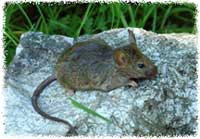 Mouse info: The house mouse weighs less than an ounce. It can fit in a crack of only a quarter inch. They can and do get everywhere. If your house has food and
has any small openings, eventually mice will find their way in. House mice eat many types of food but prefer seeds and grain. Mice
are primarily nocturnal, they can dig, they gnaw like all rodents do, and they can produce a tremendous
number of offspring.
Mouse info: The house mouse weighs less than an ounce. It can fit in a crack of only a quarter inch. They can and do get everywhere. If your house has food and
has any small openings, eventually mice will find their way in. House mice eat many types of food but prefer seeds and grain. Mice
are primarily nocturnal, they can dig, they gnaw like all rodents do, and they can produce a tremendous
number of offspring.
Biology -
The common house mouse are small rodents living with human beings and are popular because of the damage they cause to crops, stored food and even clothes. Humans enjoy them as pets and scientists use them for clinical and scientific testing. Their body length varies from 7.5 to 10 cm while the tail adds another five to ten cm. They weigh around 10 to 25 grams and have been found in a variety of fur colors including white, grey, brown and black. They can jump vertically to about 45 cms, have strong smell and a high pitched squeak. Interestingly, they use all four legs for walking and running, but in case they attack someone or are trying to eat, they stand up on the two hind legs and use the tail as a third supporting arm. Using the two free arms, they hold their food and eat. They are also good swimmers and climbers and are usually seen during the night hours. They like eating plants but are omnivorous in nature.
They cannot see colors but are able to hear the ultrasonic sounds and use both human audible range and ultrasonic range for communication.
Habitat -
House mice usually live in places habited by human beings. They are found in our homes, shops, factories, mines, storage areas and mills. They find small openings in walls to enter the home and will even chew away holes if there is not an accessible way into the home. In the rural areas, they stay in poultry farms, woodpiles or make their burrows in the ground.
Life Cycle and Reproduction -
The females become sexually receptive after 72 hours if exposed to male urine. The cycle will continue for four to six days. However, if more than one female mouse is kept in a crowded place, they will never be sexually receptive. After copulation, a vaginal plug is developed in female mice and thus further copulation is prevented. The gestation period lasts for about 19 to 21 days and three to fourteen babies are born at a time. One female can give birth five to ten times in a year. The new ones are born without fur and are blind. They open their eyes after about 14 days of birth. Males reach sexual maturity after eight weeks while females take six weeks.
They can survive up to a maximum of three years. However, there were a few genetically modified mice that lived for four to five years.
Diseases they carry -
The common house mouse causes diseases like Murine Typhus, Plague, Rickettsialpox and Tularemia to name a few. Murine Typhus causes headache, fever, nausea, vomiting, cough and chills and has symptoms similar to measles or rubella. Plague can cause decomposition of human skin while a person is still alive and can even result in death. Other diseases they cause includes Salmonellosis which is also known as bacterial food poisoning, Lymphocytic, Leptospirosis characterized by fever and jaundice, Choriomeningitis, Ratbite fever caused due to the bite of a mouse, Lyme disease resulting in cardiac and neurological disorders, Dermatitis and Favus. They are also carriers of tapeworm which are parasitic in nature and can reside in the intestine of human beings.
Nuisance -
They cause a lot of nuisance that result in economic damage as well. While staying in our homes or commercial areas, they consume and feed upon stored food either meant for us or the pets. They are also responsible for contaminating the food with their droppings, urine or fur. An important thing to understand here is that though they consume only three grams of food per day, they destroy a much bigger amount as they have a habit of discarding partially eaten items. In fields, they dig up newly planted grains. They also damage wooden structures as they chew them away to make their home. They chew away wires which results in electric short circuits. This can result in fire hazards and a lot of money is spent in the repair process.
Here are some additional articles about how to get rid of mice that you might like to read:
How to catch mice alive
How to keep mice away
Mouse removal methods
Mouse in the wall scratching
The Fastest Way To Get Rid Of Mice
Home Remedies To Keep Away Mice And Get Rid Of Them
Select Your Animal

Rats Rat Removal Advice & Information

Mice Mouse Removal Advice & Information

Raccoons Raccoon Removal Advice & Information

Squirrels Squirrel Removal Advice & Information

Opossum Opossum Removal Advice & Information

Skunks Skunk Removal Advice & Information

Moles Mole Removal Advice & Information

Groundhog Groundhog Removal Advice & Information

Armadillos Armadillo Removal Advice & Information

Beaver Beaver Removal Advice & Information

Fox Fox Removal Advice & Information

Coyotes Coyote Removal Advice & Information

Birds Bird Removal Advice & Information

Bats Bat Removal Advice & Information

Snakes Snake Removal Advice & Information

Dead Dead Animal Removal Advice & Information

OthersOther Wildlife Species Advice & Information