-
info@aaanimalcontrol.com
Call us for help in your town
Humane Wildlife Education
Big Brown Bat Photograph
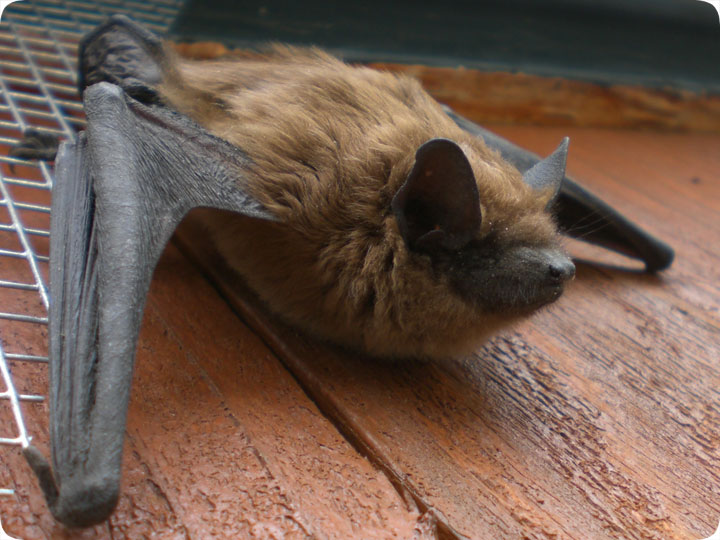


09.09.2008 - This is a detail photograph of a Big Brown Bat (Eptesicus fuscus). The Big Brown is a common bat involved in nuisance wildlife removal, because like
the Little Brown Bat, it's a colonizing mammal that likes to live in buildings. It looks fairly similar to the Little Brown Bat, except it's ...bigger. It has a
wingspan of maybe 10 inches and it weighs 5/8 oz, which while small, is quite a bit larger than your average colonizing bat.
I don't deal with Big Brown Bats here in
Florida. I deal with the Freetails and the Evening Bats. The Big Brown is more common up north. This photo was sent to me by my friend Sean, who operates his
own wildlife removal business in Seattle. It's a high quality picture, so I'm posting it here.
Even though I don't personally deal with Big Brown Bats, it's my
understanding that the colony sizes are generally smaller than those of other species. A colony might consist of ten to twenty members, whereas the Little Browns or
Freetails can form colonies of thousands of members.
Regardless of colony size, the behavior is the same. They form maternity colonies of females, they give birth
to young in the summer, they leave their roost at night to catch insects on the wing, and sleep during the day. They are controlled via exclusion methods - one-way
removal devices that let them fly out but not fly back in. They are valuable creatures that should not be killed.
Do it yourself: Visit my How To Get Rid of Bats page for tips and advice.
Get professional help: Visit my Nationwide Pro Directory of wildlife removal experts.
Biology of Big Brown Bat - The big brown bats are 110-130 mm length. The females are larger than the males and they have strong sharp teeth. Their teeth are used to bite preys especially when they catch using mouth. Thus, despite the size of its prey, they are able to capture them. The big brown bat has dark brown color with a slight red shade on their skins. Their bottom part is light brown and their wings, tail, ears and face are dark black.
The big brown bats live in Nearctic region and neotropical region. The southern Canada and United States are also their habitats. Along the mountain chain of Andean and some islands include Hispaniola, cuba, Jamaica and Puerto rico.
The habitats for big brown bats are the rural areas or the towns. The bats can blend in human habitats such as the hollows of the trees, stadiums, churches and even barns. The big brown bats also inhabit the streams like rivers and forests. They can adapt to the weather and the environment.
Bats can survive until 19 years. They are wild animals and most of the males live longer. If the bats don't have enough fat during their hibernation, they will surely die in winter. The big brown bats are taken care by the mothers in large groups. They are recognized by the mothers and mothers usually lick the baby before they start to nurse them.
To capture their preys, bats use echolocation. They make calls by opening their mouths and also calculate the distance between the call and the length. This is how they have precise calculation when attacking and hunting the preys. They listen to echoes and they can determine their distance from the object. They use this method also when they are flying. When big bat is close to the prey, they can increase the rate.
Baby brown bats may separate from the mothers. This is why they squeak continually to seek their mother. The distance is far enough for the squeak to be heard – up to 30 feet. The squeak is part of the way they communicate. Moreover, the squeak can help the mother to note their location and find them. Or take them somewhere safe.
Big brown bats feed on beetles and other insects. They use their teeth to chew hard surfaces like the shells of insects. The warm month is the perfect roost for these bats to catch preys because they have to hibernate during the winter. When digesting their meals, they hang themselves upside down before returning to capture the preys. Snakes and raccoon eat bats and sometimes the owl catch them when they fly.
Big Brown Bats are one of a kind and a special type of mammal. Also known as Eptesicus fuscus, these bats are common in the United States, North America, and other parts of the world. The average length of this bat is 120mm, making them one of the smallest mammals in the world.
Unlike other mammals, Big Brown Bats have a distinctive and weird appearance. Its wings, face, tail, and ears are completely black and fully packed with brown fur. Right here, we will be sharing all you need to know about Big Brown Bats. This includes their biology, life cycle, habitat, and behaviors.
Biology & Life Cycle
Big Brown Bats are one of the few mammals that raise their young together with other nursing mothers. To do this, they create a colony of nursing mothers which can be up to 25-30 mothers. During this period, they care for their young together and make sure they are all healthy. The males don't take part in nurturing their young. During this time, they roost around alone and go about their own activities.
Male and female bats mate between winter and fall. Conception doesn't take place until spring after winter and fall hibernation. The females have an internal sac which they use to store sperm collected from the male until the weather is favorable for conception.
The babies of Big Brown Bats are born blind. As a result of this, they solely depend on their mother for nourishment and food. It usually takes a young Big Brown Bat four to six weeks before it gets strong enough to fly and take care of itself.
Big Brown Bats have a life expectancy of 18 to 20 years. However, a larger percentage of these bats don't make it past their first winter season because their body doesn't have enough calories to keep them in hibernation throughout the winter.
Habitat
Big Brown Bats have a well-developed adaptive system. They usually do well in any kind of environmental condition. You can find them in meadows, mountains, deserts, and even cities. So don't be surprised if you see them flying over the roof in your neighborhood.
Diet
When it comes to their diet, Big Brown Bats feed on a wide range of things, but mainly they are insectivorous. They feed on all kinds of insects including, moths, wasps, flies, fly ants, and other small bugs. Just like every other animal in the wild, they also have their natural predators. Animals like cats, snakes, and raccoons are always looking forward to having them as food.
Conclusion
Big Brown Bats are amusing animals with unique behaviors. If you have them in any part of your home, you must look for a humane way to get rid of them. Big Brown Bats can cause a nuisance in your home if not removed.
Select Your Animal

Raccoons Raccoon Removal Advice & Information

Squirrels Squirrel Removal Advice & Information

Opossum Opossum Removal Advice & Information

Skunks Skunk Removal Advice & Information

Rats Rat Removal Advice & Information

Mice Mouse Removal Advice & Information

Moles Mole Removal Advice & Information

Groundhog Groundhog Removal Advice & Information

Armadillos Armadillo Removal Advice & Information

Beaver Beaver Removal Advice & Information

Fox Fox Removal Advice & Information

Coyotes Coyote Removal Advice & Information

Birds Bird Removal Advice & Information

Bats Bat Removal Advice & Information

Snakes Snake Removal Advice & Information

Dead Dead Animal Removal Advice & Information

OthersOther Wildlife Species Advice & Information