-
info@aaanimalcontrol.com
Call us for help in your town
Humane Wildlife Education
Possum in a cage in an attic
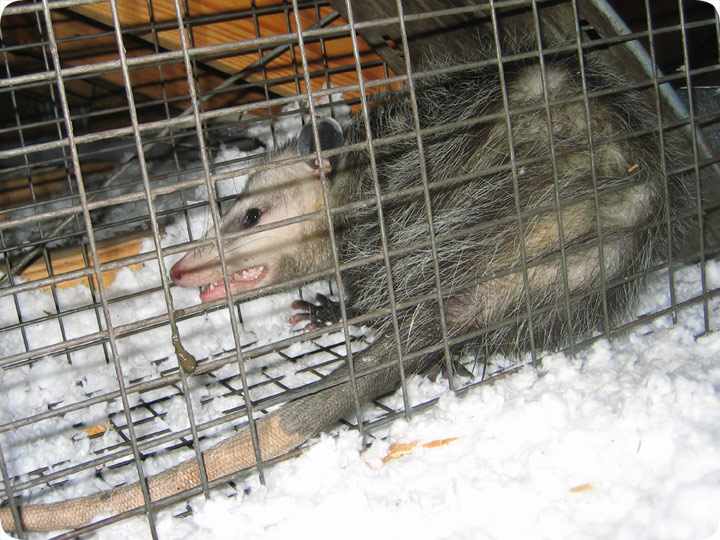


12.16.2005 - This was a somewhat typical possum in the attic job. I went to a home to inspect regarding some noises in the attic. When I got in the attic, it was easy
to tell that the culprit was an opossum. Possum droppings are very distinct.
I inspected the roof and the soffits, and found a very large and easy entry point at
one of the eave gaps. I set some traps right at the hole on the roof, and sure enough, I'd caught two opossums the next morning. It's rare to get two, but I knew
that this meant that I was dealing with a winter denning group. In the winter here in FL, multiple opossums will gather together to den for the winter.
Because I
didn't know how many possums were living in the attic, nor whether they'd all go outside or not, I set additional traps inside the attic. Sometimes winter possums will
stay inside for a very long time. However, they don't hibernate, and I knew that I could entice them with some nice canned cat food as bait. The customer was still
hearing noises in the attic despite the removal of the two opossums on the roof.
The next morning after setting the cage traps in the attic, the customer heard some
clang-clang-clanging from one area of the attic, and when I went up to inspect my trap, I saw the above sight. I caught a third opossum. My roof traps didn't catch
anything, and the newspaper I'd stuffed in the hole was not touched, so I knew that no animals went in or out that night.
I left a few traps on the roof and in the
attic, but there was no more activity. Three opossums was the total take. I removed the traps and cleaned up the opossum poop, and sealed that last hole, and now
the home is critter-free.
Do it yourself: Visit my How To Get Rid of Opossums page for tips and advice.
Get professional help: Visit my Nationwide Pro Directory of wildlife removal experts.
The opossum, (Didelphis virginiana) is a nocturnal animal that lives in North America. It is a marsupial, which means that the females give birth to tiny young, who grow in a pouch. These young eventually cling to the mother's back and drop off when they are large enough.
Opossums are unique for many reasons. They have opposable thumbs, prehensile tails, 50 teeth, and several other unusual features. They are omnivores who eat almost anything, they have excellent immune systems, and they rarely live more than 2-3 years in the wild. They are most
commonly considered a nuisance species when they live in an attic or other structure, such as under a shed, or steal pet food or threaten animals.
For more wildlife stories, click my Wildlife Blog
or click my below banner to hire a local trapper.
Possums are wild and angry creatures, and they look it too. Their white ghostly faces, sharp teeth, and loud hissing are terrifying. Imagine facing all of that when you trap a possum in a cage in an attic. Let's cover what to do and what to look out for when it comes to caged possums.
Habitat of Possums
Possums live in attics, under porches, and in crawlspaces when it comes to attractive areas of your house. They are creatures of solitude, but they are very aggressive and protective.
Know that a possum most likely didn't choose your attic on a whim, there is something that drew it there. By identifying that characteristic, you can prevent possums from making your home their home in the future. Things like open food bags and pet food attract them, so putting those items away properly is the best way to prevent future possum intrusions.
What to Do with a Possum in a Cage?
If you have a possum in a cage in your attic, the hardest part is still ahead of you. Catching the possum was the easiest step, now you have to get it out of your house safely.
Distant Removal
You can drive the possum out to a distant, but safe, part of the woods that's not near your home (or anyone else's) to release it. Make sure you wear thick rubber gloves, long sleeves, and long pants just in case it tries to attack while you open the cage. Really, there's no right way to do it other than protecting yourself and get away as fast as possible.
Calling a Specialist
Calling a pest control or wildlife specialist is always the best bet when it comes to wild animal removal, including possums in a cage in an attic. These specialists know exactly how to handle these aggressive creatures, as well as releasing them into an area that can healthily support their lifestyle.
Time of Day
Since these are nocturnal creatures, it's best to handle the cage during the day when they are usually asleep. Of course, covering the cage helps keep them calm and they may not find comfort from being in a cage in the first place.
Keep in mind that the purpose isn't to kill them, it's to relocate them. Possums are wild nocturnal animals that are just looking for food and shelter. Maybe it's flattering that they chose your home, but either way, it's safer if they're removed. Catching them and moving them or calling a specialist are the best two methods for taking care of a possum problem in an attic.
Select Your Animal

Raccoons Raccoon Removal Advice & Information

Squirrels Squirrel Removal Advice & Information

Opossum Opossum Removal Advice & Information

Skunks Skunk Removal Advice & Information

Rats Rat Removal Advice & Information

Mice Mouse Removal Advice & Information

Moles Mole Removal Advice & Information

Groundhog Groundhog Removal Advice & Information

Armadillos Armadillo Removal Advice & Information

Beaver Beaver Removal Advice & Information

Fox Fox Removal Advice & Information

Coyotes Coyote Removal Advice & Information

Birds Bird Removal Advice & Information

Bats Bat Removal Advice & Information

Snakes Snake Removal Advice & Information

Dead Dead Animal Removal Advice & Information

OthersOther Wildlife Species Advice & Information