-
info@aaanimalcontrol.com
Call us for help in your town
Humane Wildlife Education
Types of Bats In Orlando
Need bat removal in your hometown? We service over 500 USA locations! Click here to hire us in your town and check prices - updated for year 2020.
The most common type of bat seen in Orlando, Florida is the Brazilian Free-Tailed Bat,
also known as the Mexican Free-Tailed Bat. This photo depicts the control and removal
of bats by AAAnimal Control bat pest removal, based out of Orlando, FL. You can see
that the bats are able to safely escape and fly away without harm. The skilled
work of this bat pest company makes sure that all of the bats, from every area of the architecture
are fully removed without harm, and more importantly, that the bats cannot get back into the structure.
We are not Florida bat exterminators, we are bat exclusion specialists. We are humane, and
do not kill bats. Bats are very valuable animals, they live a long time, and are protected by law.
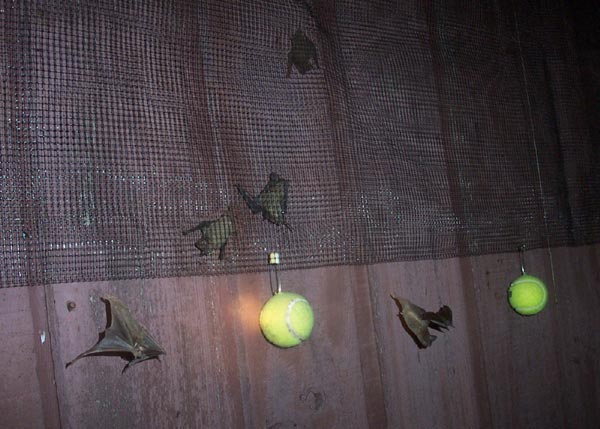
Bat control at an Orlando apartment complex by Florida Commercial Bat Control Company, AAAnimal Control: 407-278-2705
Here is a list of types of colonizing bats located in Orlando FL.
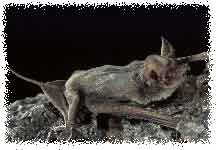 One of the most abundant bats in Florida is the Brazilian Free-tailed Bat. This is the big one. Almost 100% of the
bat removal work I do is free-tails. Their range extends throughout the state, and I've seen them in attics of all kinds, from tiny one-story
homes to huge resorts. They love to live under tile roofs, which provide plenty of gaps for them to enter.
Brazilian free-tailed bats like hot temperatures quite a bit, and I've seen them
living in incredibly hot tile roofs and attics.
One of the most abundant bats in Florida is the Brazilian Free-tailed Bat. This is the big one. Almost 100% of the
bat removal work I do is free-tails. Their range extends throughout the state, and I've seen them in attics of all kinds, from tiny one-story
homes to huge resorts. They love to live under tile roofs, which provide plenty of gaps for them to enter.
Brazilian free-tailed bats like hot temperatures quite a bit, and I've seen them
living in incredibly hot tile roofs and attics.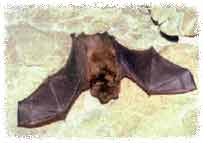 The Big Brown Bat is found in the northern half of the state, but not often by me. This bat is fairly common throughout
much of the United States, but it's just not as suited to Florida as the free-tail, which takes up most of the resources. These bats
really seem to love to live in man-made structures, with attics being a top choice. Under tiles, in gaps under bridges, in stadium gaps,
pretty much any warm safe space they can squeeze into is fine by them.
The Big Brown Bat is found in the northern half of the state, but not often by me. This bat is fairly common throughout
much of the United States, but it's just not as suited to Florida as the free-tail, which takes up most of the resources. These bats
really seem to love to live in man-made structures, with attics being a top choice. Under tiles, in gaps under bridges, in stadium gaps,
pretty much any warm safe space they can squeeze into is fine by them.
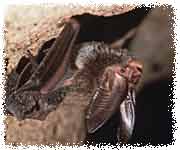 The Rafinesque's Big-eared Bat is easy to identify, what with its incredibly large ears. Imagine if you had ears
of a little more than an inch long. This bat may live behind tree bark or in hollowed out trees, but will of course live in any
suitable place, such as a building. However, you'll probably never see one, and neither will I, as it is quite rare. Poor
Rafinesque, if only he knew what was becoming of his bat.
The Rafinesque's Big-eared Bat is easy to identify, what with its incredibly large ears. Imagine if you had ears
of a little more than an inch long. This bat may live behind tree bark or in hollowed out trees, but will of course live in any
suitable place, such as a building. However, you'll probably never see one, and neither will I, as it is quite rare. Poor
Rafinesque, if only he knew what was becoming of his bat.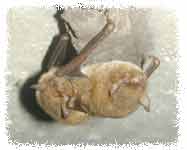 The Southeastern Myotis tends to live near streams, ponds and lakes, because like all bats, it flies right to water for
a nice drink before it dines on delicious beetles, moths and mosquitoes. In Florida, these bats remain active
throughout winter and feed year round. Southeasterns are primary cave roosters, and Florida is the place for the SE Myotis. Most of the
maternity caves are located in this state, what with it being the most Southeasternish Myotisish state in the union and all.
The Southeastern Myotis tends to live near streams, ponds and lakes, because like all bats, it flies right to water for
a nice drink before it dines on delicious beetles, moths and mosquitoes. In Florida, these bats remain active
throughout winter and feed year round. Southeasterns are primary cave roosters, and Florida is the place for the SE Myotis. Most of the
maternity caves are located in this state, what with it being the most Southeasternish Myotisish state in the union and all.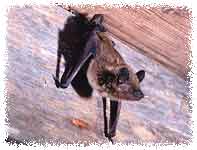 The Evening Bat is fairly common throughout FL. They are real small. If you find one, you might think that you've found a
baby bat. Of course, it's rare for anyone to find bats at any time, so you probably won't. But if you find a small bat, and it doesn't
have a free tail, it's probably an Evening Bat. Lucky day! You might in fact find one, because not only are they somewhat common (second
to the free-tailed), but because they just love to live in buildings. They are named the Evening Bat because they are active in the evening.
Fancy that, from a bat!
The Evening Bat is fairly common throughout FL. They are real small. If you find one, you might think that you've found a
baby bat. Of course, it's rare for anyone to find bats at any time, so you probably won't. But if you find a small bat, and it doesn't
have a free tail, it's probably an Evening Bat. Lucky day! You might in fact find one, because not only are they somewhat common (second
to the free-tailed), but because they just love to live in buildings. They are named the Evening Bat because they are active in the evening.
Fancy that, from a bat!For more info, go back to the Orlando bat removal page. AAAnimal Control is a professional nuisance wildlife control company. Services include animal trapping, capture & removal, plus animal damage repairs and preventative measures. We also offer biological cleanup and many other pest control services. You can always browse this site for more details and info, and you can even check out prices ahead of time. If you need a local trapper in your area, click here for a nationwide list of 100's of professional wildlife control experts.

Select Your Animal

Raccoons Raccoon Removal Advice & Information

Squirrels Squirrel Removal Advice & Information

Opossum Opossum Removal Advice & Information

Skunks Skunk Removal Advice & Information

Rats Rat Removal Advice & Information

Mice Mouse Removal Advice & Information

Moles Mole Removal Advice & Information

Groundhog Groundhog Removal Advice & Information

Armadillos Armadillo Removal Advice & Information

Beaver Beaver Removal Advice & Information

Fox Fox Removal Advice & Information

Coyotes Coyote Removal Advice & Information

Birds Bird Removal Advice & Information

Bats Bat Removal Advice & Information

Snakes Snake Removal Advice & Information

Dead Dead Animal Removal Advice & Information

OthersOther Wildlife Species Advice & Information