-
info@aaanimalcontrol.com
Call us for help in your town
Humane Wildlife Education
RAT RELATED HEALTH HAZARDS & DISEASES
Need rat removal in your hometown? We service over 500 USA locations! Click here to hire us in your town and check prices - updated for year 2020.
Here is information on common diseases caused by rats, as gathered from the Center For Disease Control & Prevention http://www.cdc.gov
We rarely see people get sick as a result of having rats in the home. However, as it is a concern, we do recommend rat removal. If you need permanent rat removal in your hometown,
click here to call us for a free price quote for rat removal - we service over 500 USA cities/towns as of 2018. But nothing beats education, so
read about the below rat-related diseases before you call, to see if you have any rat disease symptoms in humans. If so, a medical expert is your best approach.
Hantavirus Pulmonary Syndrome (HPS):
Hantavirus pulmonary syndrome (HPS) is a deadly disease transmitted by infected rodents through urine, droppings, or saliva. Humans can contract the disease when they breathe in aerosolized virus. HPS was first recognized in 1993 and has since been identified throughout the United States. Although rare, HPS is potentially deadly. Rodent control in and around the home remains the primary strategy for preventing hantavirus infection.
Murine Typhus:
Murine typhus (caused by infection with R. typhi) occurs worldwide and is transmitted to humans by rat fleas. Flea-infested rats can be found throughout the year in humid tropical environments, but in temperate regions are most common during the warm summer months. Travelers who visit in rat-infested buildings and homes, especially in harbor or riverine environments, can be at risk for exposure to the agent of murine typhus.
Rat-bite fever (RBF):
Rat-bite fever (RBF) is a systemic bacterial illness caused by Streptobacillus moniliformis that can be acquired through the bite or scratch of a rodent or the ingestion of food or water contaminated with rat feces.
Salmonella enterica serovar Typhimurium:
As its name suggests, it causes a typhoid-like disease in mice. In humans S. Typhimurium does not cause as severe disease as S. Typhi, and is not normally fatal. The disease is characterized by diarrhea, abdominal cramps, vomiting and nausea, and generally lasts up to 7 days. Unfortunately, in immunocompromized people, that is the elderly, young, or people with depressed immune systems, Salmonella infections are often fatal if they are not treated with antibiotics.
Leptospirosis:
Leptospirosis is a bacterial disease that affects humans and animals. It is caused by bacteria of the genus Leptospira. In humans it causes a wide range of symptoms, and some infected persons may have no symptoms at all.
Symptoms of leptospirosis include high fever, severe headache, chills, muscle aches, and vomiting, and may include jaundice (yellow skin and eyes), red eyes, abdominal pain, diarrhea, or a rash. If the disease is not treated,
the patient could develop kidney damage, meningitis (inflammation of the membrane around the brain and spinal cord), liver failure, and respiratory distress. In rare cases death occurs.
Eosinophilic Meningitis:
Eosinophilic meningitis is an infection of the brain occurring in association with an increase in the number of eosinophils,
white blood cells that are associated with infection with worms that penetrate into the body. The organism most commonly
causing eosinophilic meningitis is a rat lung worm called angiostrongylus cantonensis.
 |
Click here for photos of rat droppings in attics. |
Click here for a nationwide list of 100's of professional rat control experts!
Educational article - how to get rid of rats
 |
 |
 |
 |
Some people are concerned about diseases caused by rats urine. It is true that fatal Leptospirosis, as discussed above, is a possibility. Rat urine was ruled the official cause of death in a recent 2018 article I read about, stating that Leptospirosis is a bacterial infection that is most commonly spread by contact with rat urine. People can contract the leptospirosis bacteria through open cuts in the skin, or via the eyes, nose or mouth, if you get the urine on your hands and wipe your eyes or nose or mouth, or if a rat pees on your food and you eat it. It is important to know that the illness is serious it is usually treatable with antibiotics.
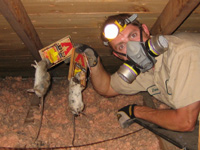
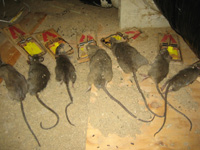
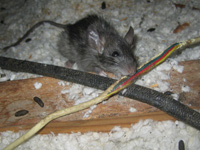
Rats seek out a warm and safe place to spend the nights, and so they go in attics. They then seek out things to gnaw on, because that's what rodents do. These disease-ridden critters are nocturnal, and can often be heard scampering up the walls and in the attic at night. They chew on electrical wires, contaminate food, and spread diseases, such as the ones outlined above. Check out my Orlando rodent control page for more information on our permanent rat control techniques. We also deal with mouse problems, which you can read about on my Orlando mouse control and mice trapping page. Mouse diseases are often different than those caused by rats, but there is some overlap.
After you read the below information, you may want to click on one of these guides that I wrote:
How much does rat removal cost? - get the lowdown on prices.
Example rat trapping photographs - get do-it-yourself ideas.
Rat job blog - learn from great examples of rat jobs I've done.
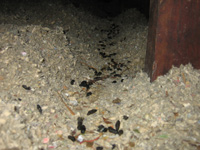
Rat droppings and disease risks - Rat droppings are small and could be easily mistaken for the regular debris that finds its way onto the floors of our homes. Many homeowners aren?t tipped off to the fact that they share their residence with a mouse until more than one nugget of feces is found, often near food. Rat droppings are more than an indication that your home?s defenses have been breached; droppings mean that there is a potential for illness, no matter how miniscule. Rodent feces carry a virus known as Hantavirus. This disease manifests itself in people with symptoms similar to those of the common cold or flu. Most people who contract this disease will need hospitalization and oxygen therapy. Hantavirus has a high mortality rate. The best method of preventing this disease is proper rodent control. If a mouse does manage to get inside of your home, use appropriate caution when cleaning up any discovered waste matter. Gloves and a mask are the basic necessities, though eye cover is also recommended. This may seem extreme for picking up the occasional rat poop, but improper safety measure on the part of the homeowner may result in expensive hospital bills later on. Mouse droppings should be picked up, not swept up. Avoid doing any activity that may circulate fecal particles through the air.

AAAnimal Control is a professional rodent control company. It is my goal to provide information so that you can solve your mouse or rat problem in an effective and responsible manner. You can always browse this site for more details and info about rat removal. If you live elsewhere in the US and have found this site and need a local trapper in your area, click here for a nationwide list of 100's of professional rat removal experts.
Example Reader Email - Someone With a Problem with Rat Diseases:
Hi, I Googled sites looking for information about the diseases and health problems that can arise from being exposed to mice and rat droppings. I work in a grocery store in Illinois and we currently have an infestation of mice and there have been sightings of a couple of rats in the back (interior) of the store. The mice right now are everywhere, I work in the bakery and we have droppings all over the bread taken out and left in walk in coolers overnight, and droppings everywhere inside the bakery department. Every day I have to clean these droppings whether it be by sweeping or cleaning off tables (tables that have "cubbyholes" in them to store plastic containers and other things we use every day in baking) While I am always cautious to wash my hands and wear gloves whenever possible, upon reading your site I came across one thing where you can actually breathe in toxins from the droppings.
This week I have come down with an ailment that I just cannot explain. I do not think I have a virus, but now I'm starting to worry if it is caused by all these droppings I keep having to clean up and what if I wasn't careful enough. I also think about the poor people who are eating this food we are making. Calling the health department is not an option, they were out here two weeks ago and there have been no write ups or whatever it is that they do. In fact, they commented on how the whole town is infested with mice, acting as if it was an excuse. I've thought about anonymous letters, but I have such a large amount of proof and disgusting photos, I would lose my job even trying to be anonymous.
Can you tell me more about how I should avoid contracting any illnesses from these animals, if I can't fix the problem, I at least want to be sure i'm protecting myself and my family from getting sick.. I appreciate your reading this e-mail and I hope to hear back from you.
Sincerely,
Sara
Select Your Animal

Raccoons Raccoon Removal Advice & Information

Squirrels Squirrel Removal Advice & Information

Opossum Opossum Removal Advice & Information

Skunks Skunk Removal Advice & Information

Rats Rat Removal Advice & Information

Mice Mouse Removal Advice & Information

Moles Mole Removal Advice & Information

Groundhog Groundhog Removal Advice & Information

Armadillos Armadillo Removal Advice & Information

Beaver Beaver Removal Advice & Information

Fox Fox Removal Advice & Information

Coyotes Coyote Removal Advice & Information

Birds Bird Removal Advice & Information

Bats Bat Removal Advice & Information

Snakes Snake Removal Advice & Information

Dead Dead Animal Removal Advice & Information

OthersOther Wildlife Species Advice & Information