-
info@aaanimalcontrol.com
Call us for help in your town
Humane Wildlife Education
Removal of a Dead Opossum in the Wall
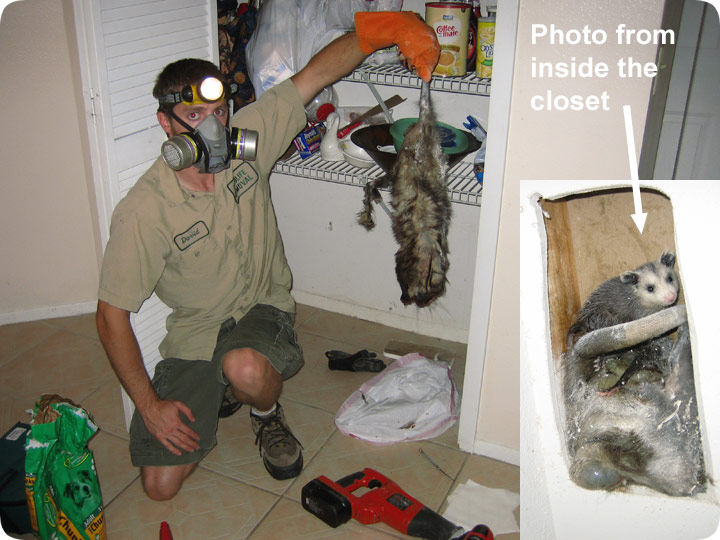


08.12.2006 - I liked this job. I was called to this house due to the horrible odor. Sometimes the dead animal odor is faint, and this one aint.
What's the past-tense of aint? Waint? Anyhow, as usual, I sniffed and I snuffed, searching for the dead animal. I had no attic space to investigate, so I
had to keep my nose on the walls. The smell was strongest in the kitchen. It's usually pretty hard to pinpoint dead animals inside walls. But I'm really
good at it. I found the wall with the strongest odor, and as luck would have it, I could make my incision from inside the kitchen closet, thereby eliminating
the need for a fancy cosmetic wall fix (which I usually do). I removed the bottom shelf from the closet, and cut a large hole in the wall just above the area
of the worst stench. Always cut just above the area - if you cut directly into the stench, you will be sorry. By sorry, I mean you and your power saw will be
drenched in juices most foul.
I cut the hole, and I was surprised to see, on top of a week-old dead opossum carcass, a live baby opossum! I carefully removed
it and placed it in a holding cage. Next, it was time to remove the dead adult. This was not easy. When animals die, they often bloat up with death gasses.
I can't describe it in more technical terms unless I do some research. So the opossum carcass was bloated, and this presents a special problem - it became
wedged in the wall. I was completely unable to pull it out, because it was stuffed in there like a blown-up balloon. That's when I invented a special tool -
a steel prod with a 90-degree bend and a sharp tip - I call it the Possum Popper. Like a weed whacker, it does what it says - it pops possums. I poked the
possum, and PSSSST!!! …out came the air, and I was able to remove the deflated opossum. Once it was out, I cleaned out the juice and gunk and guts and stuff,
and soaked the area in BioShield, and then I fixed the hole. Problem solved!
Do it yourself: Visit my How To Find and Get Rid of Dead Animals page for tips and advice.
Get professional help: Visit my Nationwide Pro Directory of wildlife removal experts.
For more wildlife stories, click my Wildlife Blog
or click my below banner to hire a local trapper.
An opossum is approximately the size of a cat with coarse grayish fur, pointed faces, and hairless, rounded ears. Easily confused with cats, they have five-toed feet. The first toe of each hind foot lacks a claw and is opposable like human thumbs.
Opossums like to scavenge around for somewhere to live. Female opossums often climb into attics during the spring when looking for somewhere warm and secure to have her young. During the winter, opossums also come indoors seeking warmth and shelter. If a homeowner has a cavity wall, it's the perfect den for an opossum, safe, secure, and warm. Opossums are great climbers, because of their opposable thumbs. Sometimes a female opossum will even give birth to her young and hide them inside a wall.
Opossums create terrible odors, even when they're alive, and are a breeding ground for parasites and diseases. The University of California says “opossums carry diseases such as leptospirosis, tuberculosis, relapsing fever, tularemia, spotted fever, toxoplasmosis, coccidiosis, trichomoniasis, and Chagas disease. They may also be infested with fleas, ticks, mites, and lice. Opossums are hosts for cat and dog fleas, especially in urban environments.”
Dead opossums create the foulest odor, which is probably what will have alerted you to the problem. Dead animals in the walls are also breeding grounds for parasites and germs, as well as attracting other creatures to your home. While dead opossums rarely carry rabies, you really want to get rid of them.
The removal of a dead opossum in a wall is done by first sniffing and finding the source of the odor. Where the smell is most potent, that is where the opossum is stuck inside the wall. A hole must be cut into the wall so that the dead opossum can be found and removed.
The only way to get dead baby opossums out of a wall is to cut the wall. This is done by following the odor and ascertaining exactly where the dead baby opossums are. Then a hole is cut into the wall so that the dead baby opossums can be removed.
If the dead baby opossums are in the attic, they just have to be found and can be removed by hand.
Opossums create a lot of droppings so you will probably want to have your attic cleaned once the creatures have been removed.
Select Your Animal

Raccoons Raccoon Removal Advice & Information

Squirrels Squirrel Removal Advice & Information

Opossum Opossum Removal Advice & Information

Skunks Skunk Removal Advice & Information

Rats Rat Removal Advice & Information

Mice Mouse Removal Advice & Information

Moles Mole Removal Advice & Information

Groundhog Groundhog Removal Advice & Information

Armadillos Armadillo Removal Advice & Information

Beaver Beaver Removal Advice & Information

Fox Fox Removal Advice & Information

Coyotes Coyote Removal Advice & Information

Birds Bird Removal Advice & Information

Bats Bat Removal Advice & Information

Snakes Snake Removal Advice & Information

Dead Dead Animal Removal Advice & Information

OthersOther Wildlife Species Advice & Information